Category: Uncategorized

  • Why Is Data Analytics Essential in Modern Digital Marketing Strategy?

    Why Is Data Analytics Essential in Modern Digital Marketing Strategy?

    Digital marketing has evolved from broad, assumption-based campaigns to highly measurable, performance-focused strategies. Today, every interaction—clicks, impressions, shares, and purchases—creates valuable data. Data analytics transforms this information into actionable insights, allowing businesses to make informed marketing decisions rather than relying on guesswork.

    By analyzing user behavior and campaign performance, marketers can identify which channels deliver the highest returns and which strategies require optimization. This data-driven approach ensures smarter budget allocation, improved targeting, and measurable business impact.

    Understanding Customer Behavior in Depth

    One of the most powerful advantages of data analytics is its ability to provide deep insights into customer behavior. Marketers can track how users discover a website, which pages they visit, how long they stay, and what motivates them to convert.

    These insights enable audience segmentation based on demographics, interests, online activity, and purchase history. Instead of sending generic messages, brands can deliver personalized experiences that resonate with specific groups. This level of relevance significantly improves engagement, trust, and long-term customer loyalty.

    For those seeking practical exposure to analytics tools and customer behavior analysis, industry-focused digital marketing training at JDM Institute equips learners with real-world skills aligned with modern marketing demands.

    Improving Campaign Performance and ROI

    Data analytics ensures that every campaign can be measured, analyzed, and optimized. Key performance indicators such as click-through rates, cost per click, conversion rates, and customer acquisition costs provide clear performance benchmarks.

    With real-time tracking, marketers can quickly identify underperforming ads or keywords and make necessary adjustments. Whether refining ad copy, adjusting targeting, or reallocating budgets, data-driven decisions lead to higher returns on investment (ROI).

    Continuous optimization ensures that marketing strategies evolve based on evidence, not assumptions.

    Precision Targeting for Better Conversions

    Reaching the right audience is essential for maximizing marketing efficiency. Data analytics allows businesses to narrow their focus to users most likely to convert.

    By studying audience insights, marketers can refine demographics, interests, and behavioral segments. Paid campaigns become more effective, reducing wasted spend and increasing engagement rates. This precision targeting not only improves conversion rates but also enhances overall campaign efficiency.

    Personalization at Scale

    Modern consumers expect personalized interactions. Data analytics enables businesses to deliver customized experiences across multiple channels.

    From personalized email recommendations to dynamic website content and retargeting ads, analytics supports tailored communication strategies. This creates a stronger emotional connection with customers and increases the likelihood of repeat purchases.

    Personalization, powered by data, turns casual visitors into loyal brand advocates.

    Strengthening SEO and Content Strategy

    Search engine optimization (SEO) relies heavily on data analysis. Keyword research, user engagement metrics, and search trends provide valuable direction for content creation.

    By analyzing search performance and user intent, marketers can develop content that aligns with audience needs. Data also highlights which pages generate traffic and which require improvement, enabling ongoing SEO optimization.

    Professionals looking to build expertise in SEO analytics can benefit from advanced analytics and SEO certification programs by JDM Institute, which emphasize practical application and measurable results.

    Gaining a Competitive Advantage

    In a crowded digital marketplace, data analytics provides a strategic edge. Businesses can monitor competitor trends, identify gaps in the market, and anticipate consumer behavior shifts.

    This proactive approach enables brands to adapt quickly to algorithm updates, industry trends, and seasonal changes. Companies that leverage analytics stay ahead of competitors by responding to data-driven insights rather than reacting too late.

    Enabling Real-Time Strategy Adjustments

    Digital marketing platforms change constantly. Algorithms update, advertising costs fluctuate, and consumer preferences shift rapidly. Data analytics allows marketers to track performance in real time and respond immediately.

    If a campaign underperforms, it can be optimized or paused instantly. If a strategy exceeds expectations, it can be scaled for greater impact. This adaptability ensures marketing efforts remain relevant and efficient.

    Connecting Marketing to Business Growth

    Data analytics bridges the gap between marketing activities and overall business performance. Metrics such as revenue per campaign, customer lifetime value, and cost per acquisition provide measurable evidence of marketing effectiveness.

    When decision-makers understand how campaigns directly impact revenue, they can make smarter long-term investments. Data-driven marketing supports sustainable growth by identifying scalable opportunities and eliminating inefficiencies.

    Building a Culture of Continuous Optimization

    Analytics fosters a mindset of experimentation and improvement. Through A/B testing and performance comparisons, marketers can determine which headlines, visuals, landing pages, and calls-to-action generate the best results.

    Small incremental improvements accumulate over time, leading to significant growth. Organizations that prioritize analytics build a culture of learning, adaptability, and measurable success.

    Conclusion

    Data analytics is the foundation of modern digital marketing strategy. It enhances audience understanding, improves targeting accuracy, strengthens personalization, and maximizes ROI. Businesses that leverage analytics outperform competitors by making informed, evidence-based decisions.

    To develop practical skills in data-driven marketing and analytics, explore our Contact Us page for digital marketing course inquiries and take the first step toward building expertise that aligns with today’s industry demands.

  • What Practical Skills Should You Expect from a Digital Marketing Institute?

    What Practical Skills Should You Expect from a Digital Marketing Institute?

    A reliable digital marketing institute should equip you with strong, practical SEO skills that go far beyond theory. You should learn how to conduct keyword research based on user intent, optimize on-page elements such as meta titles and descriptions, structure content for higher search visibility, and improve technical aspects like indexing and site speed. Most importantly, you should gain hands-on experience auditing websites and building actionable SEO strategies.

    The ability to analyze ranking performance, identify content gaps, and implement optimization techniques prepares you for real-world marketing challenges. When choosing a reputed and industry-focused digital marketing training institute in India like JDM Institute – professional digital marketing training institute in India, ensure the curriculum includes live SEO projects and practical assignments.

    Performance Marketing and Paid Advertising Execution

    Paid advertising is a core component of modern digital marketing. A strong institute should train you to create, manage, and optimize ad campaigns across platforms such as Google Ads and social media networks. You should understand audience targeting, bidding strategies, campaign structuring, budget allocation, and conversion tracking.

    Practical exposure is critical. You must practice setting up campaigns, writing compelling ad copy, and analyzing ROI metrics. Hands-on learning ensures you can confidently manage advertising budgets and improve campaign performance based on real data insights.

    Social Media Strategy and Content Planning

    Social media marketing requires strategic planning, not random posting. A quality digital marketing program should teach you how to create structured content calendars, understand platform algorithms, build engagement strategies, and measure campaign effectiveness.

    You should gain experience designing brand-focused campaigns, improving reach organically, and leveraging paid promotions for faster growth. Practical projects such as creating a social media strategy for a business help develop skills that are directly applicable in agency or corporate roles.

    Content Marketing and Copywriting Expertise

    Content marketing plays a central role in driving traffic and conversions. A professional institute should train you to write SEO-friendly blogs, persuasive landing pages, engaging email newsletters, and high-converting ad copies.

    You should understand audience psychology, buyer journeys, and storytelling frameworks. Practical writing assignments help refine both creativity and strategic thinking. Strong content skills significantly enhance your value as a digital marketer.

    Analytics and Data Interpretation Skills

    Data-driven marketing separates average marketers from high-performing professionals. Institutes should teach you how to use analytics tools to track traffic sources, user behavior, conversion funnels, and campaign outcomes.

    You should be able to interpret reports, identify improvement areas, and adjust strategies accordingly. Practical exercises involving dashboard analysis ensure you can convert numbers into meaningful marketing insights that drive business growth.

    Website Management and Conversion Optimization

    A digital marketer must understand how websites function as conversion tools. Practical training should include basic website management, landing page optimization, user experience fundamentals, and conversion rate optimization (CRO) techniques.

    You should learn how page structure, call-to-action placement, design clarity, and load speed impact lead generation. Institutions that offer comprehensive and job-oriented digital marketing certification programs with practical exposure such as JDM Institute’s industry-oriented digital marketing certification courses ensure students develop these essential website optimization skills.

    Email Marketing and Automation

    Email marketing remains one of the highest-return digital channels. A strong institute should teach you how to build subscriber lists, segment audiences effectively, create automated workflows, and design email campaigns that convert.

    You should gain practical experience crafting subject lines that improve open rates and writing persuasive content that drives clicks. Automation tools and nurturing sequences should be part of your hands-on training.

    Marketing Strategy and Funnel Development

    Beyond learning individual tools, you should develop the ability to build complete digital marketing strategies. This includes defining target audiences, mapping customer journeys, creating marketing funnels, and allocating budgets across channels.

    Institutes should provide case studies and scenario-based assignments where you create integrated campaigns combining SEO, paid ads, social media, and content marketing. Strategic thinking is what makes you industry-ready rather than just tool-aware.

    Freelancing and Client Management Skills

    Many aspiring marketers aim to freelance or start their own agency. A practical digital marketing program should teach proposal creation, pricing models, client communication, and performance reporting.

    Understanding how to present measurable results and manage client expectations prepares you for independent projects and long-term professional growth.

    Portfolio Development and Career Readiness

    A reputable institute ensures you graduate with live project experience and a strong portfolio. Resume-building workshops, mock interviews, and placement guidance further enhance your career readiness.

    If you are serious about building job-ready skills, choosing an institute that focuses on real implementation rather than just theoretical lessons is essential. To explore course details, batch schedules, or personalized career guidance, visit the Contact Us page for digital marketing course inquiries and take the next step toward a successful digital marketing career.

  • What Makes Digital Marketing Training Truly Industry-Relevant Today?

    What Makes Digital Marketing Training Truly Industry-Relevant Today?

    Digital marketing is no longer limited to social media posting or basic website promotion. It has evolved into a data-driven, technology-powered ecosystem that demands strategic thinking, technical expertise, and adaptability. Industry-relevant digital marketing training today must go beyond theory and focus on preparing learners for real business challenges. The true value of such training lies in its ability to bridge the gap between classroom learning and professional execution.

    A Curriculum That Reflects Current Market Needs

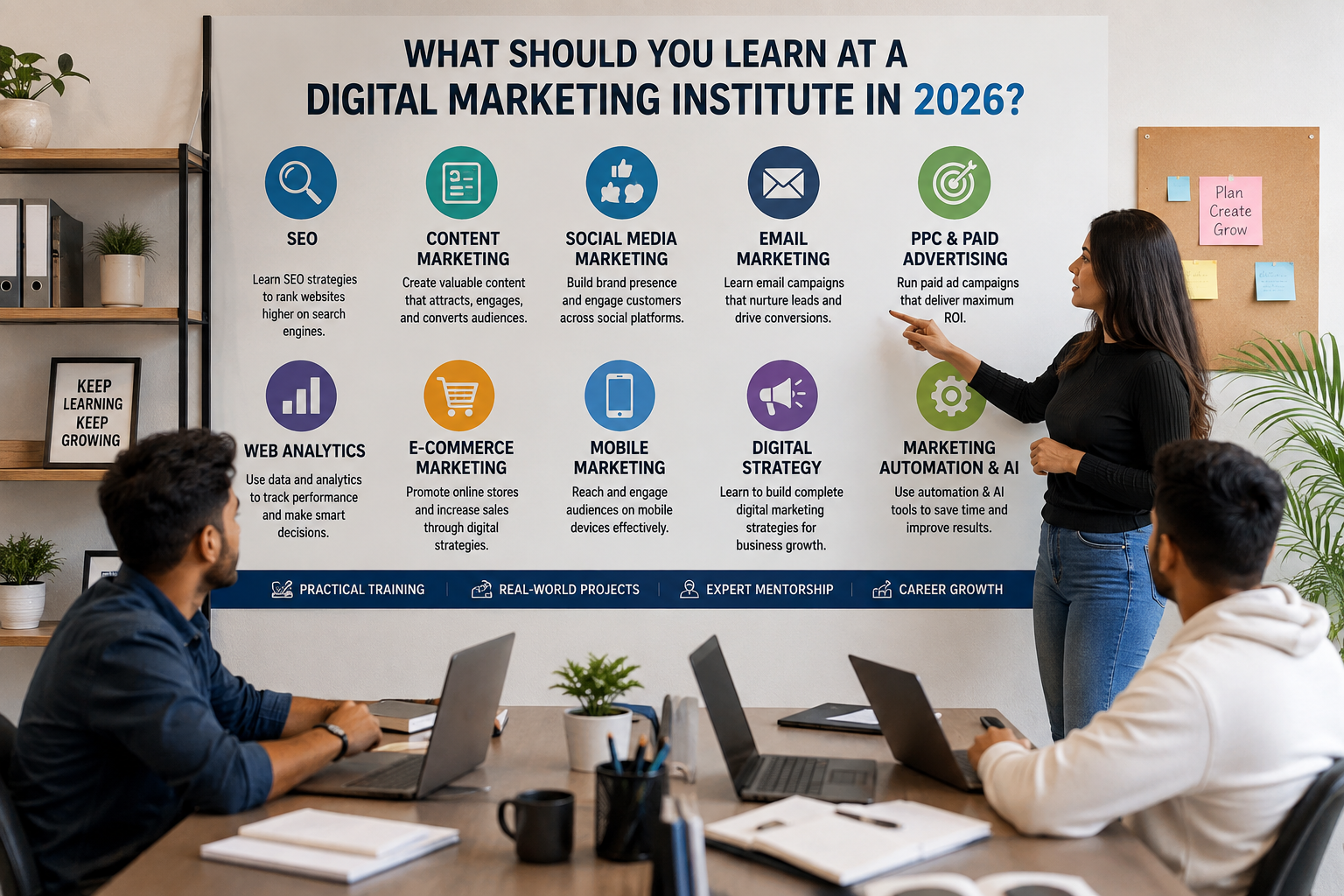
    The digital marketing landscape changes rapidly. Search engine algorithms update frequently, advertising platforms introduce new features, and consumer behavior shifts continuously. An industry-relevant program must reflect these changes in its curriculum. It should comprehensively cover SEO, performance marketing, social media strategy, content marketing, marketing automation, analytics, and AI-driven tools.

    Most importantly, the syllabus should be continuously updated. When training aligns with real hiring demands and current platform practices, learners gain skills that employers actively seek. This ensures graduates are not just certified but job-ready.

    Practical, Hands-On Learning with Real Tools

    Digital marketing is a skill-based profession. Watching lectures alone cannot build expertise. Students must actively work on advertising platforms, analytics dashboards, SEO tools, and automation systems.

    Hands-on training should include launching ad campaigns, conducting keyword research, optimizing landing pages, analyzing campaign performance, and preparing client reports. Practical implementation builds confidence and prepares students to manage real budgets and deliver measurable results.

    Institutes like JDM Institute – professional digital marketing training institute emphasize experiential learning environments where students apply strategies in simulated or live campaign settings. This approach ensures learners understand both the technical and strategic sides of digital marketing.

    Data-Driven Decision Making as a Core Skill

    Modern marketing decisions are driven by analytics, not assumptions. Industry-ready professionals must know how to track performance, interpret data, and optimize campaigns based on measurable insights.

    Training programs should teach students how to analyze key metrics such as CTR, CPA, ROAS, engagement rate, and conversion rates. Additionally, learners should understand A/B testing, attribution models, and performance reporting frameworks. The ability to translate data into actionable strategy is what distinguishes high-performing marketers.

    Integration of AI and Marketing Automation

    Artificial intelligence has become central to digital marketing workflows. From AI-assisted content generation to automated bidding strategies in paid ads, technology now enhances both efficiency and performance.

    Industry-relevant training includes exposure to AI tools, automated email sequences, chatbots, CRM integrations, and predictive analytics. Understanding how to strategically leverage automation not only improves productivity but also prepares learners for future industry advancements.

    Real-World Projects and Portfolio Development

    Employers prioritize demonstrated skills over theoretical knowledge. That is why live projects and portfolio creation are essential components of relevant training.

    Students should complete website audits, run campaign simulations, build content calendars, and create performance reports. A strong portfolio proves practical capability and significantly improves job interview outcomes.

    At JDM Institute – industry-focused digital marketing courses, project-based learning ensures that students graduate with real work samples they can confidently present to employers or clients.

    Industry Mentorship and Career Readiness

    Learning from experienced professionals adds immense value. Trainers who actively manage campaigns bring practical insights about client communication, budget optimization, and evolving marketing trends.

    Industry mentorship also includes interview preparation, resume guidance, and portfolio review. Career-oriented programs prepare students not only to perform tasks but to present themselves effectively in competitive hiring environments.

    Preparing for Multiple Career Paths

    Digital marketing offers diverse career opportunities, including full-time roles, freelancing, agency positions, and entrepreneurship. Industry-relevant training equips learners with skills beyond technical execution.

    Students should learn how to pitch services, draft proposals, price projects, manage client expectations, and deliver performance reports. These skills expand career possibilities and provide long-term professional flexibility.

    Ethical Marketing and Compliance Awareness

    With increasing attention to data privacy and user protection, marketers must understand compliance standards and responsible advertising practices. Training should cover ethical data collection, consent-based tracking, and transparent reporting methods.

    Professionals who balance growth strategies with ethical responsibility build stronger brand trust and sustainable careers.

    Continuous Learning and Adaptability

    Perhaps the most crucial element of industry relevance is adaptability. Digital platforms evolve constantly, and successful marketers must stay updated with algorithm changes, new tools, and emerging trends.

    Quality training programs cultivate a mindset of continuous improvement, experimentation, and strategic testing. This ensures learners remain competitive even as the industry transforms.

    Conclusion

    Industry-relevant digital marketing training is defined by practical exposure, updated curriculum, data-driven strategies, AI integration, mentorship, and strong career support. It prepares learners not just to understand marketing—but to execute it effectively in real business environments.

    If you want structured guidance and hands-on learning aligned with current industry standards, you can explore programs or directly connect through the official Contact JDM Institute for digital marketing course inquiries page for personalized assistance.

    In today’s competitive digital landscape, choosing the right training can accelerate your transition from learner to industry-ready professional.

  • How Gamification Can Skyrocket Customer Engagement in Marketing

    How Gamification Can Skyrocket Customer Engagement in Marketing

    As a marketer, I’ve always been fascinated by the ways we can capture attention in a world overflowing with content. Over the years, I’ve noticed that traditional marketing strategies—while effective to a degree—often fail to create deep, lasting engagement. That’s when I discovered gamification, and it completely transformed the way I connect with customers. Today, I want to share how gamification can increase customer engagement in marketing and why it’s becoming a game-changer for brands.

    Understanding Gamification in Marketing

    At its core, gamification is the application of game mechanics and principles in non-game contexts. In marketing, this means integrating elements like points, rewards, challenges, or leaderboards into campaigns to make the customer experience interactive and enjoyable. When I first experimented with gamified campaigns, I was skeptical. Could adding badges or small challenges really make a measurable difference? The answer, as it turns out, is a resounding yes.

    Gamification taps into basic human psychology. We all love achievements, competition, and rewards. When a campaign triggers these emotions, it encourages users not only to participate but also to return repeatedly. I’ve found that even simple gamification techniques, like earning points for signing up for a newsletter or completing a product survey, significantly boost engagement metrics.

    Creating Meaningful Interactions

    One of the most important lessons I’ve learned is that not all gamification is created equal. For it to increase customer engagement, the interaction must be meaningful. A pointless game or reward can feel manipulative and actually harm your brand. I always ask myself: what value does this add to the customer experience?

    For example, I worked on a campaign where users unlocked design tips and tutorials by completing small creative challenges. The engagement was incredible because the game mechanics were tied directly to learning and improvement—customers weren’t just collecting points; they were gaining tangible value. That’s when I realized that gamification works best when it aligns with your brand’s purpose and enhances the customer journey.

    In fact, exploring expert resources like JDM Institute’s creative marketing and design programs in the middle of my learning journey helped me refine these strategies. Their in-depth courses showed me how to integrate gamification effectively while keeping the user experience meaningful and engaging.

    Encouraging Participation Through Rewards

    Rewards are a central aspect of gamification, but they don’t always have to be monetary. I’ve found that recognition and social validation often work just as well, if not better. Features like leaderboards or badges can spark friendly competition among users. When I added a “Top Contributor” badge to a user community, participation jumped dramatically. Customers were motivated not by cash, but by acknowledgment and status within the community.

    Offering tiered rewards can also extend engagement over time. In one of my campaigns, I set up a points system where customers could unlock higher-tier rewards for sustained interaction. This strategy encouraged repeat visits and created a sense of progression—an essential aspect of any game. Customers began anticipating what they could achieve next, and engagement metrics soared.

    Personalization Enhances Gamification

    Another critical insight I’ve gained is the power of personalization. When gamified experiences are tailored to a user’s behavior and preferences, engagement skyrockets. I used personalized quizzes in one campaign to recommend products, and the results were impressive: completion rates increased by over 40%, and customers reported feeling more connected to the brand.

    Personalization makes gamification feel like a conversation rather than a one-sided marketing push. By understanding your audience and customizing challenges or rewards, you can create experiences that resonate on a deeper level. For example, a fashion brand could offer style-based challenges, while a tech brand might focus on skill-building quizzes. Either way, the key is relevance.

    Measuring Success and Adjusting Strategies

    Gamification isn’t a set-it-and-forget-it strategy. In my experience, continuous tracking and optimization are essential. I closely monitor metrics like participation rates, time spent on campaigns, social sharing, and conversion rates. When something isn’t working, I tweak the challenge, reward, or user interface to make it more engaging.

    I also encourage marketers to experiment with A/B testing. Sometimes small changes—like adjusting the difficulty of a challenge or the type of reward—can dramatically increase engagement. Gamification is dynamic, and your strategies should be too.

    The Role of Gamification in Brand Loyalty

    Perhaps the most exciting aspect of gamification is its ability to foster brand loyalty. Customers who engage in gamified experiences feel a stronger emotional connection to the brand. In my campaigns, I’ve seen repeat engagement translate into higher customer retention and advocacy. Gamification encourages ongoing interaction, making customers feel invested in your brand story.

    When done right, it can even turn your audience into brand ambassadors. Customers who enjoy the gamified experience are more likely to share it with friends and family, extending your reach organically. It’s a win-win: your brand gains visibility, and customers gain enjoyable experiences.

    Start Your Gamification Journey

    If you’re looking to increase customer engagement, gamification is a strategy worth exploring. From rewards and challenges to personalized interactions, it transforms marketing into an interactive experience that customers want to participate in. I’ve seen firsthand how it boosts engagement, loyalty, and overall satisfaction.

    If you’re curious about implementing these strategies in your campaigns, don’t hesitate to Contact Us for personalized guidance and marketing solutions. Even a small gamified element can make a big difference in how customers interact with your brand.

    By embracing gamification, I’ve transformed my marketing from static messages into dynamic, interactive experiences. And the results speak for themselves: higher engagement, stronger loyalty, and a more enjoyable experience for both customers and marketers alike. For anyone serious about growing their brand, gamification isn’t just an option—it’s a must.

    For more insights into creative marketing strategies, JDM Institute offers expert guidance and courses to help you stay ahead of the curve. By combining gamification with smart strategy, your brand can captivate its audience and keep them coming back for more.

  • How Can User-Generated Content Build Brand Trust Effectively?

    How Can User-Generated Content Build Brand Trust Effectively?

    When I look at how people interact with brands today, one truth stands out clearly—trust is no longer built by advertising claims. It’s built by real people sharing real experiences. No matter how refined a brand’s messaging is, it will never feel as credible as users speaking in their own voice. This is why user-generated content (UGC) has become one of the most effective ways to build brand trust.

    User-generated content includes reviews, testimonials, social media posts, comments, videos, and case studies created by customers. When used correctly, it creates authenticity, credibility, and emotional connection—all of which are essential for long-term trust.

    Trust Is the Starting Point of Every Conversion

    Before users buy, subscribe, or enroll, they look for reassurance. I’ve seen countless prospects hesitate simply because they couldn’t find proof that others trusted the brand before them. Today’s users research deeply, compare options, and seek validation.

    UGC answers these doubts naturally. Instead of telling people your brand is reliable, you let customers show it through their experiences. This shift instantly makes your message more believable.

    Authentic Content Builds Emotional Connection

    The biggest advantage of user-generated content is authenticity. Real users don’t follow scripts or marketing language. They talk honestly about challenges, progress, and outcomes—and that honesty resonates.

    In my experience, a genuine testimonial or informal review often builds more trust than polished promotional content. People relate to stories that feel human, and trust grows when users feel understood.

    Social Proof Reduces Risk and Doubt

    One of the main reasons people hesitate is fear of making the wrong decision. User-generated content reduces that fear. When users see others achieving results, they feel more confident moving forward.

    This psychological reassurance, known as social proof, plays a major role in decision-making. It shows prospects that your brand delivers real value—not just promises.

    Using UGC to Demonstrate Transparency

    Trust strengthens when brands are transparent. Sharing honest feedback—including constructive opinions—shows confidence and accountability. I believe brands that openly display user voices appear more reliable and mature.

    Responding to reviews and engaging with feedback also signals that a brand listens. This interaction humanizes the business and builds credibility over time.

    Real Stories Strengthen Brand Authority

    User-generated content doesn’t just build trust—it reinforces authority. When learners, customers, or clients share success stories, they demonstrate real-world results that prospects can relate to.

    This approach is especially powerful for education-focused brands. For example, platforms offering practical digital marketing education and skill-based learning at JDM Institute highlight real student experiences to establish credibility and trust through proven outcomes.

    Turning Customers Into Brand Advocates

    One of the most powerful outcomes of UGC is advocacy. When people voluntarily share experiences, they become ambassadors for your brand. I’ve noticed that users who feel valued and heard are more likely to promote a brand organically.

    Encouraging participation through feedback requests, recognition, or community features creates loyalty. Over time, this turns your audience into a trust-building ecosystem.

    SEO Benefits That Support Trust Building

    User-generated content also strengthens search visibility. Reviews and testimonials naturally include keywords and fresh content, which improves relevance for search engines.

    Websites that consistently feature UGC often see longer engagement times and higher credibility signals. These factors not only boost rankings but also reinforce trust with new visitors.

    Encouraging UGC the Right Way

    The best user-generated content comes from genuine satisfaction, not pressure. I’ve found that asking for feedback at the right moment—after a positive experience—works best. A simple follow-up message or acknowledgment goes a long way.

    Educational brands such as career-focused digital marketing training by JDM Institute effectively leverage learner voices to maintain authenticity while building long-term trust.

    Final Thoughts

    User-generated content works because it replaces marketing claims with real proof. It allows potential customers to see themselves in others’ experiences, making trust feel natural and earned.

    If you want to build stronger brand credibility through authentic engagement and community-driven content, feel free to contact our team for personalized guidance and support.

    At the end of the day, trust isn’t created by what brands say—it’s built by what real users experience and are willing to share.

  • How Can Chatbots Enhance Customer Service and Marketing ROI?

    How Can Chatbots Enhance Customer Service and Marketing ROI?

    When I first explored chatbots for business, I assumed they were just automated responders—helpful, but limited. Over time, I realized their potential goes far beyond answering simple queries. Chatbots, when used strategically, can enhance customer service, increase engagement, and directly boost marketing ROI. In this blog, I’ll share how chatbots can transform both customer interactions and business performance.

    Instant 24/7 Customer Support

    One of the most obvious advantages of chatbots is their ability to provide immediate assistance. Today’s customers expect fast responses, and delays often lead them straight to competitors. Chatbots handle FAQs, order tracking, appointment scheduling, and basic troubleshooting without human intervention.

    From my experience, deploying a chatbot reduces wait times, increases customer satisfaction, and lowers the number of support tickets. Human agents are freed to handle complex issues, while customers feel valued at every stage of their journey. The result is better service efficiency and a more scalable support system.

    Personalized Conversations That Engage

    Many people assume chatbots feel robotic, but modern solutions can deliver highly personalized experiences. Using user data, browsing history, and past interactions, chatbots can greet returning visitors by name, suggest products based on previous purchases, or guide users through tailored sales funnels.

    I’ve seen businesses increase conversion rates significantly when chatbots provide a human-like, personalized experience. Learning to design these intelligent conversational flows is one reason why professional programs like JDM Institute’s advanced digital marketing courses are so valuable—they teach actionable strategies for combining AI, automation, and customer engagement effectively.

    Automatic Lead Capture and Qualification

    Chatbots are excellent tools for lead generation. Unlike static forms, chatbots engage visitors in real time, asking questions that qualify leads instantly. I’ve used chatbots to segment users by intent, budget, and urgency, automatically routing high-potential leads to sales teams while nurturing colder prospects through follow-up messages.

    This automated lead qualification ensures marketing efforts are directed at the most promising prospects, shortening sales cycles and improving overall ROI.

    Cost Reduction and Efficiency Gains

    A single chatbot can manage thousands of conversations simultaneously, something a human team could never achieve. This scalability reduces operational costs while maintaining high-quality customer service.

    Integrating chatbots with CRM and marketing automation tools provides even more benefits. Businesses can track behavior, refine campaigns, and target users more effectively. From my perspective, every rupee or dollar spent on chatbot-driven campaigns works harder, delivering measurable returns. Investing in JDM Institute’s practical automation and marketing training can teach teams how to implement these strategies successfully.

    Boosting Customer Retention and Loyalty

    Customer engagement doesn’t stop at the point of sale. Chatbots help maintain relationships through proactive messaging, order updates, and feedback collection. I’ve observed brands using chatbots to deliver post-purchase instructions, tips, and satisfaction surveys.

    These interactions build trust, keep customers returning, and foster loyalty—crucial elements for sustainable marketing ROI. A well-designed chatbot strategy ensures that customers feel supported long after their initial purchase.

    Data-Driven Marketing Insights

    Every interaction with a chatbot generates valuable data. This data reveals customer preferences, frequently asked questions, pain points, and engagement trends. By analyzing these insights, I’ve been able to refine campaigns, improve targeting, and optimize messaging.

    Companies that integrate chatbots effectively can continuously test and adjust their strategies. Marketers trained at JDM Institute for advanced marketing analytics and AI-driven strategies leverage this data to create more efficient campaigns and maximize ROI.

    Seamless Omnichannel Experience

    Today, customers interact with brands across multiple channels—websites, social media, messaging apps, and more. Modern chatbots operate across all these platforms, providing consistent support and communication.

    From my perspective, this omnichannel presence ensures customers don’t have to repeat themselves and creates a seamless experience. It also increases conversion opportunities, as prospects can engage wherever they are most comfortable.

    Conclusion

    Chatbots are no longer just a nice-to-have—they are a strategic asset that can enhance customer service while boosting marketing ROI. They improve engagement, reduce costs, qualify leads automatically, and provide actionable insights for smarter campaigns.

    If you want to explore the full potential of chatbots and learn how to implement them in your business for maximum ROI, I recommend you contact us for expert guidance on AI-powered marketing and customer service automation. Leveraging these tools can transform your customer interactions into a scalable growth engine.

  • What Makes JDM Institute a Hub for Future-Ready Technical Education?

    What Makes JDM Institute a Hub for Future-Ready Technical Education?

    In a rapidly evolving digital-first world, the demand for skill-based, industry-aligned technical education has never been greater. Students and professionals alike are increasingly searching for institutes that not only impart knowledge but also prepare them to thrive in modern workplaces driven by technology, innovation, and continuous learning. As industries undergo large-scale transformation fueled by advanced tools and the need for multi-skilled talent, one institution consistently stands out in bridging the gap between education and employment—a true hub for future-ready technical learning.

    A Vision Centered on Industry Demand

    What makes any educational institution future-ready is its approach toward changing industry landscapes. The reason JDM Institute stands apart is its vision to empower students with skills that are directly aligned with current market needs. Rather than following traditional academic models that often lag behind real-world applications, the institute emphasizes practical competency, hands-on training, and outcome-based learning—key elements required to build a career in today’s competitive ecosystem.

    To further demonstrate its commitment to accessibility and quality, JDM Institute ensures that learning pathways are designed for students from diverse backgrounds, whether they are entering the job market for the first time or seeking skill enhancement for career advancement.

    Comprehensive Technical Programs Tailored for the Future

    Being future-ready means understanding not only the present but also anticipating what skills will be relevant tomorrow. JDM Institute offers an expansive range of technical and vocational courses designed to reflect evolving technological trends. These programs cater to domains where the demand for skilled professionals is consistently high.

    The curriculum highlights:

    • Practical training modules that allow learners to apply concepts in real scenarios
    • Advanced tools and technologies integrated into classroom teaching
    • Industry-relevant certifications that add credibility to students’ profiles
    • Flexible learning formats, making education accessible regardless of schedule or background

    This dynamic approach ensures that learners are not merely completing a course—they are building careers grounded in technical proficiency.

    Hands-On Learning Through Practical Exposure

    One of the most defining traits of a future-ready educational hub is its commitment to practical learning. In an era where employers prioritize skills over degrees, hands-on exposure becomes essential. JDM Institute’s training ecosystem is built around workshops, real-world tasks, live assignments, and interactive sessions that simulate professional environments.

    Students are encouraged to work on real challenges that strengthen their analytical abilities, technical expertise, and decision-making skills. Whether through project-based learning or role-specific practical sessions, this experiential methodology enables learners to confidently step into the workforce with job-ready abilities.

    Experienced Faculty and Industry Mentors

    Future-ready education cannot exist without the guidance of experienced educators who understand the pulse of modern industries. JDM Institute boasts a team of highly skilled trainers, mentors, and subject matter experts who bring years of hands-on industry experience to the classroom.

    Their guidance ensures that every concept—no matter how complex—is delivered in a practical, digestible manner. This mentor-driven training approach plays a vital role in shaping students’ technical competencies and professional mindset, giving them a competitive advantage in the job market.

    Modern Infrastructure and Technology-Driven Learning Environment

    The institute’s infrastructure also plays a crucial role in shaping future-ready professionals. Equipped with updated tools, modern learning labs, and technology-driven classrooms, JDM Institute ensures that learners gain exposure to the same advanced equipment used in professional environments.

    This emphasis on providing a realistic training atmosphere helps students build familiarity with current technologies, software, and tools—essential steps in developing technical confidence.

    Strong Focus on Career Development and Placement Support

    Future-ready technical education is incomplete without strong placement support. JDM Institute empowers students with an ecosystem dedicated to their career growth, offering:

    • Portfolio-building assistance
    • Resume and interview preparation
    • Workshops on communication and professional behavior
    • Job placement assistance through industry partnerships

    This comprehensive career support ensures that students not only acquire knowledge but also transition smoothly into the workforce with confidence and clarity.

    Skill Development with Real-World Relevance

    Modern industries value multi-skilled individuals capable of handling diverse responsibilities. Recognizing this, JDM Institute promotes a holistic skill development approach that nurtures:

    • Technical competency
    • Problem-solving ability
    • Creativity and innovation
    • Professional communication
    • Adaptability and teamwork

    By refining these skills, the institute prepares learners to excel in dynamic work environments where continuous adaptation is key.

    Student-Centric Support System

    A strong support system contributes significantly to the success of future-ready learners. JDM Institute ensures that students have access to guidance at every step of their learning journey. The institute maintains open communication channels, responsive assistance, and approachable faculty—creating a nurturing environment that drives motivation and confidence.

    To make it easier for prospective students to explore programs, connect with the institution, or seek admission details, the institute offers direct support through its Contact Us page, ensuring quick and reliable assistance.

    A Hub for Future-Ready Technical Professionals

    In an age where skills define success, JDM Institute positions itself as a transformative center for technical education. Its combination of modern curriculum, experienced faculty, advanced infrastructure, hands-on training, and career-focused learning makes it a preferred destination for learners seeking long-term success in the technical domain.

    More than an institute, it is a platform where students are empowered to become future-ready professionals equipped to thrive in evolving industries. Whether someone is beginning their career or upgrading their skills, JDM Institute offers the right blend of innovation, practical knowledge, and industry relevance.

  • How Can JDM Institute Transform Skills for the Modern Automotive Industry?

    How Can JDM Institute Transform Skills for the Modern Automotive Industry?

    The automotive industry is undergoing one of the most significant transformations in its history. With rapid advancements in electric vehicles, hybrid technologies, automation, diagnostics, and smart manufacturing, traditional mechanical skills alone are no longer sufficient. Today’s automotive professionals must blend hands-on technical expertise with digital knowledge, problem-solving abilities, and adaptability to evolving technologies. This shift has created a strong demand for institutions that not only teach theory but also prepare learners for real-world automotive challenges. This is where skill-focused training organizations play a critical role in shaping the future workforce.

    As the gap between industry requirements and conventional education widens, learners increasingly seek institutes that offer practical exposure, updated curricula, and industry relevance. Among such institutions, JDM Institute stands out for its commitment to transforming raw talent into job-ready automotive professionals equipped for the modern era.

    The Changing Landscape of the Automotive Industry

    The modern automotive sector is no longer limited to engines, gears, and mechanical repairs. Innovations such as electric powertrains, advanced driver-assistance systems (ADAS), vehicle diagnostics software, and connected car technologies have reshaped the industry. Workshops and service centers now rely heavily on diagnostic tools, software-based fault detection, and precision engineering.

    This evolution demands a new breed of technicians and engineers who understand both mechanical systems and electronic integrations. Employers are actively looking for candidates who can handle modern vehicles confidently, interpret diagnostic data, and adapt to new technologies quickly. Traditional classroom-based education often struggles to keep pace with these industry shifts, creating a need for specialized skill-development institutes.

    Bridging the Skill Gap Through Practical Learning

    One of the biggest challenges facing the automotive workforce today is the skill gap. Many graduates possess theoretical knowledge but lack hands-on experience with modern tools and technologies. This gap directly impacts employability and productivity.

    Institutions like JDM Institute address this challenge by focusing on practical, industry-aligned training. Instead of relying solely on textbooks, learners are exposed to real automotive systems, live projects, and workshop environments that mirror actual industry conditions. This practical approach helps students develop confidence, technical accuracy, and problem-solving skills that employers value highly.

    Industry-Relevant Curriculum and Modern Tools

    A key factor in transforming skills is the relevance of the curriculum. The automotive industry evolves rapidly, and outdated syllabi can leave learners unprepared. JDM Institute emphasizes an updated curriculum designed to align with current industry standards and technological trends.

    From engine diagnostics and electrical systems to emerging automotive technologies, learners gain exposure to tools and techniques used in real workshops and service centers. Training on modern diagnostic equipment, testing methods, and repair strategies ensures that students are not only knowledgeable but also operationally efficient from day one.

    Learning Beyond Technical Skills

    While technical expertise is essential, success in the modern automotive industry also depends on soft skills, workplace discipline, and professional ethics. Communication, teamwork, time management, and customer handling are crucial in service-oriented roles.

    Skill development at JDM Institute goes beyond technical instruction. Learners are encouraged to develop a professional mindset, understand workplace expectations, and build confidence in their abilities. This holistic development approach helps students transition smoothly into professional environments and adapt to diverse job roles.

    Empowering Learners for Career Growth

    The ultimate goal of any training institute is to improve career outcomes for its learners. In the automotive sector, this means enabling individuals to secure stable jobs, grow professionally, or even start their own ventures.

    By providing hands-on training and exposure to real-world challenges, JDM Institute empowers learners to explore various career paths within the automotive industry. Whether it is working in authorized service centers, independent workshops, manufacturing units, or diagnostic facilities, students are better prepared to seize opportunities and grow within the industry.

    Supporting the Vision of Skill-Based Education

    India’s growing emphasis on skill-based education highlights the importance of vocational and technical training. As industries demand job-ready professionals, institutes that focus on practical skills become essential contributors to economic growth.

    JDM Institute aligns with this vision by creating a bridge between education and employment. Its focus on skill transformation supports not only individual career growth but also the overall development of a skilled automotive workforce capable of meeting future industry demands.

    A Trusted Platform for Aspiring Automotive Professionals

    Choosing the right training institute is a critical decision for anyone aspiring to build a career in the automotive field. Factors such as quality of training, infrastructure, industry relevance, and support systems play a vital role in long-term success.

    JDM Institute has positioned itself as a trusted platform by prioritizing learner outcomes, industry alignment, and practical exposure. Its structured training programs and learner-centric approach make it a reliable choice for those who want to stay ahead in a competitive and technology-driven automotive industry.

    Taking the First Step Toward a Skilled Future

    The automotive industry’s transformation presents both challenges and opportunities. Those who invest in upgrading their skills and adapting to modern technologies will find themselves well-positioned for success. Institutes that focus on hands-on training and industry relevance act as catalysts in this journey.

    For individuals seeking guidance, training details, or enrollment information, the best way forward is to reach out directly through the official Contact Us page. Taking this step can open doors to skill enhancement, career growth, and long-term success in the modern automotive industry.

    Conclusion

    The future of the automotive industry belongs to skilled, adaptable, and industry-ready professionals. As vehicles become smarter and technology-driven, the need for specialized training will only grow stronger. By focusing on practical learning, updated curricula, and holistic skill development, JDM Institute plays a crucial role in transforming learners into confident professionals ready for modern automotive challenges.

    For anyone looking to build or upgrade their career in this dynamic industry, investing in the right skills through the right institution can make all the difference.

  • Which Digital Strategies Boost Brand Awareness Most Effectively Today

    Which Digital Strategies Boost Brand Awareness Most Effectively Today

    In today’s hyper-connected world, brand awareness is no longer simply a matter of catchy slogans or memorable logos. Digital strategies play a crucial role in ensuring that a brand not only reaches its target audience but also creates a lasting impression. With the rise of social media, search engine algorithms, and influencer marketing, businesses need to leverage a combination of approaches to stay ahead. But which strategies are truly the most effective in 2025? Let’s explore.

    The Power of Social Media Marketing

    Social media platforms remain one of the most potent tools for increasing brand visibility. With billions of users worldwide, platforms such as Instagram, Facebook, LinkedIn, TikTok, and Twitter offer brands a direct line to engage with their audience.

    Effective social media marketing goes beyond posting content sporadically. Brands that see the most success often focus on creating consistent, high-quality content that resonates with their target demographic. Utilizing features like Instagram Reels, LinkedIn Articles, and TikTok Trends allows businesses to reach a larger audience organically. Additionally, paid advertising options on these platforms, when executed strategically, can significantly amplify reach and awareness.

    Another key element is community engagement. Responding to comments, hosting live sessions, and initiating interactive content like polls and challenges can strengthen a brand’s identity and encourage users to actively share content, multiplying its reach.

    Search Engine Optimization (SEO) and Content Marketing

    While social media offers rapid engagement, SEO and content marketing provide long-term benefits that sustain brand visibility. Optimizing a website for search engines ensures that your business appears prominently when users search for relevant topics, products, or services.

    Blog posts, articles, and informative content that address audience pain points are essential for building authority. A company like JDM Institute, which focuses on enhancing professional skills, benefits greatly from content marketing by providing educational materials that attract learners and industry professionals alike. This not only drives organic traffic but also positions the brand as an industry thought leader.

    Moreover, long-tail keywords, meta descriptions, and internal linking strategies help improve search rankings while creating a better user experience. When combined with shareable content, SEO becomes a powerhouse for sustained brand awareness.

    Influencer and Affiliate Marketing

    Influencer marketing has matured into a mainstream strategy, and for good reason. Collaborating with influencers who share your brand values and appeal to your target audience can create authentic engagement. Influencers often have dedicated followers who trust their recommendations, making them ideal partners for promoting products or services.

    Similarly, affiliate marketing allows brands to expand their reach by incentivizing partners to promote offerings. When executed strategically, affiliate and influencer marketing campaigns can significantly enhance visibility and attract new customers who may not have discovered your brand through traditional channels.

    Video Marketing and Live Streaming

    Video content continues to dominate digital consumption habits. Platforms like YouTube, Instagram, TikTok, and even LinkedIn have made video an essential part of any brand awareness strategy. Videos offer a dynamic way to showcase products, explain services, or tell a brand story. Short-form videos, particularly, have seen explosive growth, as they are more likely to be shared and consumed repeatedly.

    Live streaming has also emerged as a key tactic for engaging audiences in real time. Whether it’s product launches, Q&A sessions, or behind-the-scenes tours, live videos create a sense of authenticity and foster a personal connection with the audience. The immediacy of live interaction can dramatically improve recognition and trust in your brand.

    Email Marketing: Still Relevant in a Digital Age

    Despite the surge in social media and video marketing, email remains one of the most effective tools for maintaining brand awareness. Personalized email campaigns allow brands to communicate directly with their audience, share valuable updates, and reinforce brand identity.

    Segmentation ensures that each subscriber receives content relevant to their interests, increasing the likelihood of engagement. Additionally, email automation makes it easier to nurture leads and maintain ongoing communication without overwhelming your marketing team. A well-crafted email campaign can be a subtle yet powerful method to keep your brand top-of-mind.

    Paid Advertising and Retargeting

    Organic strategies are invaluable, but paid digital advertising accelerates visibility and helps brands reach highly targeted audiences. Google Ads, social media advertising, and programmatic ad campaigns allow precise targeting based on demographics, behavior, and interests.

    Retargeting, in particular, has proven extremely effective. By showing ads to users who have already interacted with your brand, businesses can reinforce awareness and increase conversion rates. Retargeting ensures that even if a potential customer doesn’t immediately act, your brand remains visible, gradually building recognition and trust.

    Leveraging Analytics for Strategy Optimization

    No digital strategy can succeed without proper measurement and optimization. Tools like Google Analytics, social media insights, and marketing dashboards allow brands to track performance, understand audience behavior, and identify the most effective tactics.

    Data-driven decisions help refine content, allocate resources wisely, and ensure maximum return on investment. Brands that continuously analyze and adjust their strategies are far more likely to achieve sustained brand awareness in an increasingly competitive digital landscape.

    The Importance of Professional Guidance

    While these strategies can be highly effective, implementing them correctly requires expertise. Many businesses turn to professional institutes and training programs to enhance their digital marketing capabilities. Organizations like JDM Institute offer specialized programs that equip marketers with the skills necessary to leverage the latest trends and tools efficiently.

    For businesses looking to take their brand awareness strategies to the next level, consulting with experts can streamline the process and avoid costly trial-and-error approaches. Professionals can provide tailored guidance, ensuring campaigns are both innovative and measurable.

    To explore further support or professional guidance in digital marketing, businesses are encouraged to Contact Us for detailed consultations, training, and strategy sessions.

    Conclusion

    Boosting brand awareness in the modern digital landscape requires a multifaceted approach. Social media engagement, SEO and content marketing, influencer collaborations, video marketing, email campaigns, and targeted paid advertising all play critical roles. By combining these strategies with data-driven insights and professional guidance, brands can not only capture attention but also build lasting connections with their audience.

    In an era where visibility equates to credibility, investing in the right digital strategies ensures that your brand not only survives but thrives in the competitive online ecosystem.

  • What Are the Latest Trends Shaping the Future of Digital Marketing

    What Are the Latest Trends Shaping the Future of Digital Marketing

    In an era where technology evolves at a lightning pace, digital marketing continues to transform the way businesses connect with audiences. Keeping up with the latest trends is no longer optional—it is essential for brands that aim to stay relevant, competitive, and impactful. From artificial intelligence to immersive experiences, the future of digital marketing promises both challenges and opportunities. Here’s an in-depth look at the trends shaping the industry and how businesses can leverage them to gain a competitive edge.

    Artificial Intelligence and Machine Learning

    Artificial intelligence (AI) has moved from being a futuristic concept to an integral part of digital marketing strategies. AI-driven tools can analyze vast amounts of consumer data, enabling marketers to create highly personalized campaigns. Predictive analytics, for instance, allows brands to anticipate customer behavior, recommend products, and optimize content for higher engagement.

    Machine learning, a subset of AI, further enhances these capabilities by continuously learning from data patterns. Platforms leveraging machine learning can automate customer segmentation, dynamic pricing, and even content creation. This trend emphasizes efficiency and accuracy, allowing marketers to focus on strategy and creativity.

    Businesses interested in harnessing AI for marketing insights can explore courses at JDM Institute, which offers comprehensive training on digital marketing technologies and tools. For more information, you can always Contact Us to learn about the latest programs designed for both beginners and professionals.

    Voice Search Optimization

    With the increasing popularity of smart speakers, virtual assistants, and voice-activated devices, voice search is becoming a crucial aspect of digital marketing. Consumers are now more likely to speak queries rather than type them, which means businesses must rethink SEO strategies.

    Optimizing for voice search involves focusing on natural language, conversational keywords, and long-tail search phrases. Local SEO also plays a pivotal role since many voice searches are location-specific. Brands that adapt early can capture the growing segment of users relying on voice search for quick, accurate information.

    For marketers seeking to master this skill, JDM Institute provides specialized courses that cover SEO trends, including voice search optimization. Interested individuals can Contact Us to get guidance on enrolling in courses that offer practical insights and hands-on experience.

    Video Marketing Dominance

    Video continues to dominate the digital landscape, with platforms like YouTube, TikTok, and Instagram Reels experiencing explosive growth. Videos are not just visually engaging—they also improve retention, increase conversions, and foster brand loyalty.

    Live streaming, short-form videos, and interactive content are becoming standard tools for engaging audiences. Brands are increasingly using videos to tell stories, demonstrate products, or even host virtual events. The key is creating content that is authentic, relatable, and tailored to the target audience.

    Digital marketing programs at JDM Institute provide comprehensive training on video marketing strategies, from production techniques to distribution tactics. To explore these offerings, simply Contact Us for personalized assistance and course recommendations.

    Personalization and Customer Experience

    In today’s competitive market, generic messaging is no longer effective. Customers expect personalized experiences that reflect their preferences, behaviors, and past interactions. Personalization extends beyond emails and advertisements—it includes website content, product recommendations, and even social media engagement.

    Advanced data analytics and AI-powered tools enable marketers to segment audiences effectively and deliver tailored experiences. Businesses that invest in personalization not only boost engagement but also foster long-term customer loyalty.

    For marketers aiming to refine their personalization strategies, JDM Institute offers courses on data-driven marketing, consumer psychology, and customer journey mapping. You can Contact Us to learn how these programs can enhance your marketing campaigns.

    Interactive and Immersive Content

    The future of digital marketing is not just about delivering information—it’s about creating experiences. Augmented reality (AR), virtual reality (VR), and interactive content such as quizzes, polls, and 360-degree videos are redefining how brands engage with audiences.

    These immersive experiences increase engagement, improve brand recall, and provide unique opportunities for product demonstrations. For instance, AR-powered apps allow customers to virtually try on products before purchasing, bridging the gap between online and offline shopping.

    Marketers looking to explore immersive content strategies can benefit from training at JDM Institute, which covers emerging technologies and creative marketing solutions. Prospective students can Contact Us for more details about enrollment and course offerings.

    Social Commerce and Influencer Marketing

    Social media platforms have evolved from engagement tools to powerful commerce channels. Social commerce integrates shopping experiences directly within platforms like Instagram, Facebook, and TikTok, enabling seamless transactions without redirecting users to external websites.

    Influencer marketing continues to thrive as well. Consumers increasingly trust recommendations from authentic voices over traditional advertisements. Collaborating with influencers helps brands reach niche audiences, increase credibility, and drive conversions.

    Courses at JDM Institute include in-depth insights into social media marketing, influencer collaborations, and social commerce strategies. For further inquiries, you can Contact Us to explore programs tailored to different business needs and skill levels.

    Data Privacy and Ethical Marketing

    As digital marketing evolves, so do concerns about data privacy. Regulatory frameworks like GDPR and CCPA have reshaped how businesses collect, store, and use consumer data. Ethical marketing practices and transparent data usage have become critical for building trust.

    Marketers must adopt strategies that respect user privacy while still delivering personalized experiences. This includes obtaining explicit consent, anonymizing data, and providing value in exchange for user information.

    Training in ethical digital marketing is part of the curriculum at JDM Institute, ensuring that marketers are well-versed in both compliance and strategy. Prospective students can Contact Us to receive guidance on courses that emphasize responsible data management.

    Conclusion

    The digital marketing landscape is dynamic, driven by innovation, technology, and evolving consumer expectations. From AI and voice search to immersive content and ethical marketing, the future demands adaptability, creativity, and strategic thinking. Businesses and marketers who embrace these trends can enhance engagement, increase conversions, and build stronger relationships with their audiences.

    For those looking to gain a competitive edge, investing in professional training is key. JDM Institute offers comprehensive programs designed to equip marketers with the latest skills and tools needed to thrive. To explore these opportunities, Contact Us today and take the first step toward mastering the future of digital marketing.